




The way most people shop for protein powder is the same.
They look at the grams of protein.
They glance at the calories.
They possibly compare flavors, sugar, or look to see if it’s plant-based or whey-based.
And then they act as though the decision has been all but made.
But that is where the real story normally gets lost. Because with protein powders, most people have no idea that the source and structure matters as well. In fact, one of the most significant advances in protein supplements has little to do with the number of grams on the front of the label. It has to do with how the protein is digested and absorbed into the body.
That may sound technical, but the concept itself is straightforward. The native structure of traditional protein powders is such that it takes longer for the body to break them down and absorb simply because they are larger. But most don’t realize that there is an emerging class of proteins that have a “pre-broken” structure. Essentially those large proteins are broken into smaller peptide building-blocks through enzymatic hydrolysis. And that difference can dramatically affect the performance and benefit for you.
This is the hidden story behind clear vegan protein powder that makes it so interesting.
What Are Pea Protein Peptides, Exactly?
In early 2024, the researchers at PlantFusion stumbled upon a novel new form of protein from pisum sativum (peas). Being an early pioneer in plant proteins for nearly 20 years, we thought we had seen everything. But this particular protein powder had been treated with a proprietary blend of enzymes in a process known as hydrolyzation. Although it sounds technical, this process has long been used on baby formula in order to make those products more palatable to a baby’s sensitive digestive system.
In layman’s terms, hydrolyzation just means that the pea protein has already been broken down into smaller bits of proteins. This not only makes digestion and absorption easier, but can unlock other benefits above and beyond what you might typically find in a supplemental protein powder.
That difference is important for two reasons;
First, the smaller peptide structures may allow for better absorption in the intestine which then facilitates higher amino acid levels in your blood stream. Human studies comparing a protein hydrolysate to its intact counterpart found that the hydrolyzed form produced 27% higher rates of appearance of dietary phenylalanine in the blood and 25–50% higher concentrations of plasma amino acids, providing support for the notion that fully-hydrolyzed or partially-hydrolyzed proteins may be digested and absorbed more rapidly than their intact forms (Koopman et al., 2009).

Second, the body is designed to process tiny peptide fragments effectively by deploying them in a more targeted manner. When the body digests large proteins, the resulting peptides can be random in shape and size (Daniel, 2004). The PlantFusion hydrolyzed protein is created by specific enzymes that break down pea protein into precise and optimized sizes and shapes. How proteins are “cut up” determines the peptide shape and size. Peptides are like mini keys that are specifically cut to be recognized by our cells. The smaller size and specific shapes of these protein fragments not only make them better absorbed, but they are more readily recognized and efficiently utilized by our cells.
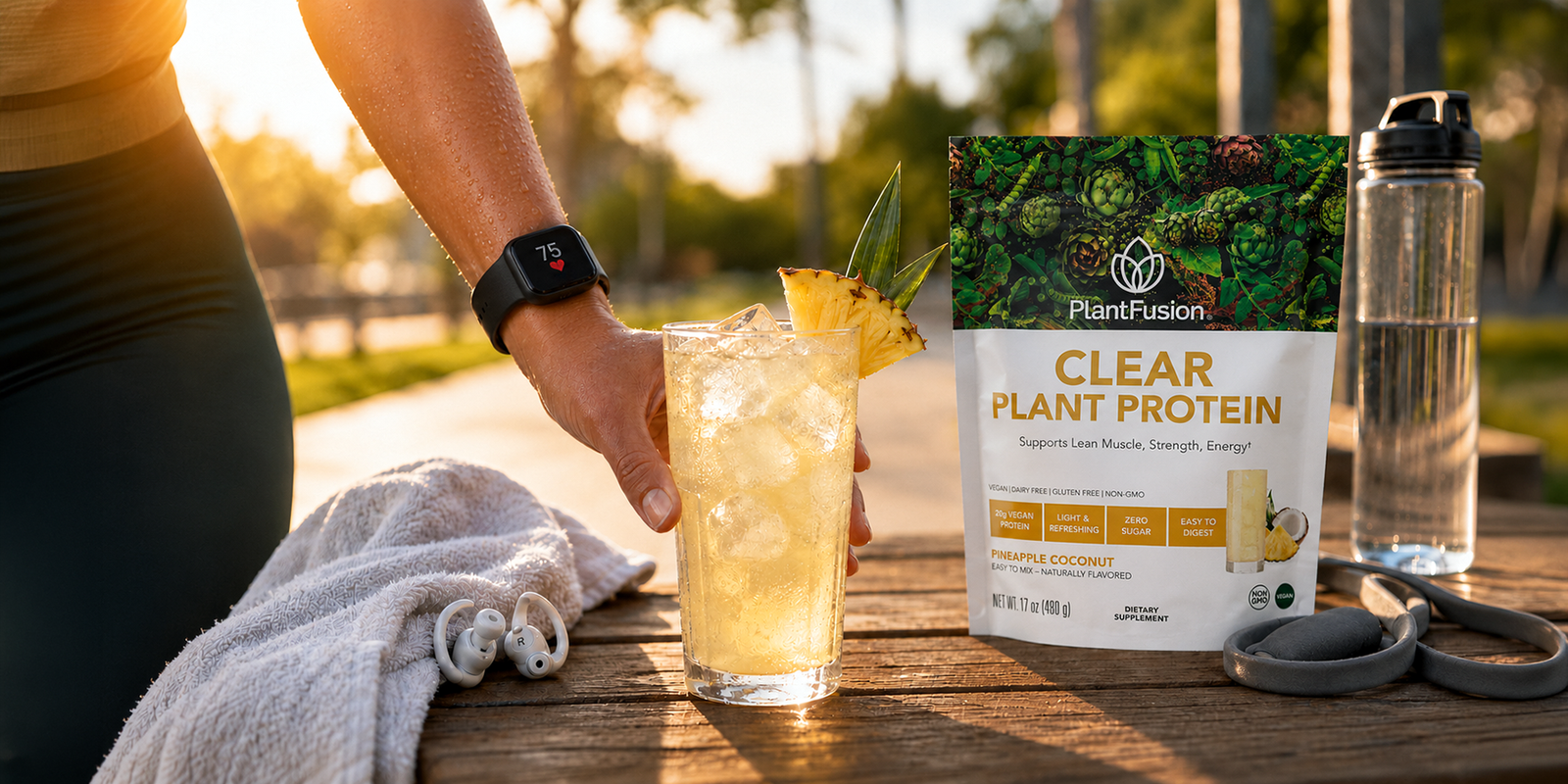
Third, a someone unexpected thing happens if large proteins are “cut up” in just the right way. It completely changes the texture of the protein so that it mixes more clear and tastes very light. If you are fatigued by the old milky chocolate, vanilla, cookies and crème thick protein shakes, proprietary hydrolyzed plant proteins create a fresher, lighter, clear protein beverage with more interesting flavors, like pineapple coconut and tropical punch.
That does not mean every hydrolyzed protein performs better than all intact proteins in all circumstances. The reality is a bit more complicated, however, it does lend credence to this idea that protein size, shape and structure can affect absorption, performance, and taste!
Clear Protein = Precision (Quality Not Quantity)
This is where the story becomes very interesting.
Protein powders have been sold for years with an almost “brute-force” mentality: bigger scoop, thicker shake, more fullness, more volume, more “substance.”
The smarter play is not always just heaping on more of the same old. For serious users, the conversation is changing to something with more precision, which is to say, more impact.
A cleaner dose. A lighter delivery. A format you can use more frequently. A satisfying protein experience that fuels your goals without slowing you down.
That’s why peptide-based clear protein powder seems like a secret weapon. It does away with old protein logic of heavy, creamy, meal-like, and establishes a new standard: targeted protein support with less drag.
And once you see that, it is difficult to unsee.

Why Advanced Health & Fitness Enthusiasts Care
Not everyone is ready for this type of innovation. Some shoppers just want the cheapest tub and the largest gram count. We don’t hold that against them.
But superusers tend to think differently. They want to know what’s going on under the hood. They want to understand why one formula behaves differently from another. They’re after the edge that comes from knowing what most labels never take time to explain.
And that’s why it feels so empowering to learn about hydrolyzed pea peptides.
It gives you a new lens.
You stop thinking of protein in antiquated categories.
You realize thick does not equal effective.
You no longer treat all protein powders as if they were interchangeable.
And you begin to see another question you should be asking:
What kind of protein delivers the experience and utility that I actually desire?
And for an increasing share of users, that answer will no longer be that old style conventional shake.
It will be something lighter, cleaner, faster, more modern, and most of all………….more intentional.
The Future of Protein Might Not Even Look Like Protein
That may be the largest lesson of all. We live in a world of rapidly changing technology. The phone you carry, the television you watch, even the appliances in your home are almost unrecognizable from those just a few decades ago. And the same is becoming true at the highest level of supplement innovation.
Are the days of thick, heavy, clumpy, chalky protein powders finally coming to end? Transformed into something clearer, more refreshing, more bioactive, more intelligently designed?
Well………..I’ll leave that to you to decide. Because only when you try it will to truly realize that plant based clear protein powder isn’t some sort of marketing gimmick. It has completely flipped the script on protein supplementation.
And those who have experienced it have discovered a new secret weapon that is already taking them to a new level of health and fitness.
References
Koopman R, Crombach N, Gijsen AP, Walrand S, Fauquant J, Kies AK, Lemosquet S, Saris WH, Boirie Y, van Loon LJ. Ingestion of a protein hydrolysate is accompanied by an accelerated in vivo digestion and absorption rate when compared with its intact protein. Am J Clin Nutr. 2009 Jul;90(1):106-15. doi: 10.3945/ajcn.2009.27474. Epub 2009 May 27. PMID: 19474134.
Daniel, H. (2004). Molecular and integrative physiology of intestinal peptide transport. Annual Review of Physiology. PMID: 12905028. https://pubmed.ncbi.nlm.nih.gov/12905028/
Boirie, Y. et al. (2009). The splanchnic response to protein hydrolysates is less inhibiting than that to the intact protein in healthy older men. The Journal of Nutrition. PMID: 19474134. https://pubmed.ncbi.nlm.nih.gov/19474134/